Friday, 13 November 2015

Deconstruction of music and sound effects

The use of sound in Film Noir

For my deconstruction I decided to look at old and modern film noirs and compare how they used sounds. 

Retro Film Noir: The Maltese Falcon (1940) 

Music/soundtrack (Non-diegetic sound) 

  • Dramatic non-diegetic jazz-like trumpets and stringed music plays during the beginning, but slowly fades out when their discussion starts. Essentially this creates the sense of anticipation before Mr Spade enters the room, as it lends mystery to events that will unfold after he steps in.

  •  It also plays again at the end, after Mr Spade slams the door, except this time it's louder and stops, then becomes more triumphant and high pitched. As a result, it intensifies the tension and establishes the climax of the scene.

The Big Sleep (1946)

Sound Effects (Diegetic sound) 


This was a very good example for sound effects: 
  • First thing you can hear cars screeching and breaking along the street outside, there's also foot steps of people scattering on the street though it becomes softer once the man is inside. This conforms to the conventions of sound in film noir as most scenes take place along the street.   
  • Rain and thunder can be heard throughout the diegetic dialogue, then the use of pathetic fallacy develops the mystery which suggests something ominous is about to happen, creating anticipation, as he seems to be doing a stake out.   

Modern Film noir/neo-noir: Sin city 2 (2014)


Music/soundtrack (Non-diegetic sound) 

  • During intervals of suspense when the men are putting in their poker chips, some ominous string music is playing especially in the beginning. However, when the man opposite the senator puts down his cards high pitch strings are playing, which also creates tension. 
  • As soon as he takes the chips over to his side, a brief base starts to play and again after he wins the game, however by the end it implements more of a jazz beat because it has a chime of a ride cymbal which is used in jazz. This is used to underscore the success and triumph of the man, as it's a more uplifting.

  • a sudden but subtle drum rhythm plays as the senator looks up after being insulted.            

Sound Effects (diegetic sound)

  •  Much emphasis is on the sliding of the poker chips, as you can hear these clearly over the non-diegetic music.    

 
  • Sounds of battle-like chanting that seem to be coming from outside the building which can be heard in a room connecting to the room where the game is being played, in parallel editing. Yet, this cannot be heard when there is a cut back to the scene poker table, and the chanting comes to an abrupt end.
  • In effect, it creates a certain isolation of the poker room as well, as secrecy as sounds of the outside can't be  heard from the outside suggesting that this is the case vice versa establishing an element of danger. In addition the woman who is observing from the other room is portrayed as a predatory,as she hinders the privacy of the location by hiding herself and spying on them, and the fact that she's in frame with the chanting outside reinforces her character as an outsider and therefore she is dangerous.     


Comparison

 The sound example in the retro noir examples encompass the essence of sound from that time period in which the film was made, such as the jazz music and typical urban sounds of the busy street e.g. cars passing. However in Sin City 2, the modern film noir or neo-noir conveys the same archetypes of non-diegetic soundtrack though it's use of low base strumming in certain parts of the extract, but uses more dramatic high pitched string sounds to address parts of tension.      


Tuesday, 10 November 2015

Practical task- Experiment of slow motion editing on action


Slow Motion Editing

 In the making

During the filming I used big rings, I decided to use these because it conveys richness and greed which often fuels the motivation in a film noir plot, for the characters.  
 
In addition I also wanted to see if I could manipulate the speed so it looked dramatic.  

To edit the clips I used a software called ghost lens, and adjusted the time lapse setting to slow everything down.


(Original clip)


 (Edited clip)

 The effect of the slow motion enables us to take in details of the fall and impact. Once the rings hit the bed, the bouncing effect was slowed down and we are forced to see the action occurring, which I thought put all the focus into the rings. I thought that this would be successful for the group's final practical as it could be placed in a scene of action to make it more dramatic.      
The clattering of rings in the original clip sounded good, however once it was slowed down it made a buzz noise which essentially ruined the clip, as it didn't seem to match the movements in the frame.  
(Original clip)


(edited clip)

I then decided to zoom out a little to see if it made a difference to the effect, when I made it into slow motion was more pleased with the outcome as we could see the more of how the rings landed. However, zooming out takes away some of the focus that was original on the rings as we can see more of the setting in this clip.   

Evaluation

One of the improvements I could develop would be to do filming from different angles, and seeing which angles worked for slow motion, and what didn't. Also another would be to eliminate the sound, and replace it with a soundtrack or other sound effect to make this more.      
On the other hand, I have learnt that camera angles is key when editing slow motion, as it could affect the point of focus during of a subject in frame.  


Monday, 9 November 2015

Practical Task - Photoshop Experiment

Photoshop Practical Task

As I already know quite a bit about Photoshop, I wanted to experiment more to further my skills and find out about effects that may come in handy during our production. 

Ageing the picture

As guns are common items found in film noir, I decided to use a generic stock photo image of a man holding a gun and edit it so it looked dramatic and as if it was from a detective film. Here is the image I started off with:


As this was a stock photo image it had a watermark over the top. For the purpose of my editing practice I wanted to remove it, and I did so using the paintbrush and clone stamp tools. As I'm only using this image to practice filters, I only did it roughly but it worked fine for this.


Then I applied several filters and adjustment layers to make the image look old. I wanted to try out new ways of doing this that I hadn't tried before, so I followed this tutorial except using black and white instead of sepia. I put all the filters that made the image look old into a group folder so it was organised.


I did them the same way as in the tutorial, and I found that the grain effect was particularly effective in making the photo look old and dated. However, my personal favourite was the glow/Gaussian blur effect which changed the photo subtly but made it look that much more dated. Here is a comparison of the black and white image with and without the glow. 


Even though it is a small change, I feel like it makes a big different in making the photo look old and could definitely be incorporated into our film. Here is the image with all of the ageing layers visible. I really like the way it turned out and found the tutorial extremely helpful.


Lighting

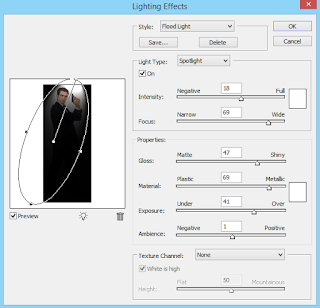
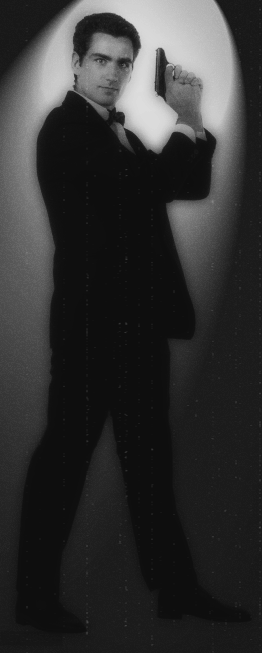
I decided to apply what I'd learnt about the lighting effects feature during the making of my production company opening to this image. I used a floodlight coming down from the top at an angle. I used a high light intensity and low ambience to make the area outside the spotlight pretty dark so that there was a greater contrast. 


Finally, I applied a plain black overlay in soft light just to darken the overall photo. Here a is the final photo with lighting effects and ageing applied, with and without the black overlay.


I'm very pleased with the overall result as I was able to make a regular looking image into something very old and vintage looking, and I feel like I can definitely use these techniques in our actual film.


Opening Scene Deconstruction: Shawshank Redemption

I chose to deconstruct this movie as it is set in 1950s America, a common setting for film noir, and revolves around gritty, heavy themes such as prison and atonement.


The scene opens with the characters being revealed by passing members of the crowd. They are in the centre of the shot and in focus, keeping the viewer's attention on them. The mise-en-scene of the prison walls in the background, along with what appears to be an iron gate, people walking around in what is obviously a uniform and one of the characters opening with "there must be a con like me in every prison in America" sets the scene immediately. It is reinforced at every angle, perhaps emphasising that prison is all there is to life for these people. The character's dialogue informs the viewer that it is set in America.
The alarm goes off and the camera angle changes to show all the prisoners look towards its source. This is also an over the shoulder shot, which along with the internal monologue, makes the main character relatable and establishes that the narrative will be viewed from his perspective.
This wide shot of the prison appears. Low, ominous music quietly plays when the white van appears, even though its contents are not revealed. This piques the viewer's curiosity, one of the strongest ways to engage an audience. The prison is in the centre of the shot, making it appear striking and somewhat threatening. It then follows into aerial panning of the prison.

The prisoners are followed from above, giving the audience a feeling of power over them, implying that they are at the bottom of society. The fact the camera follows them creates a feeling of watching them, reflective of the prison's watchdog security.
The inside of the van is finally shown, parallel to the protagonist explaining that "Andy came to the prison in 1947". Whilst there are many people in the van, it is obvious who the main character is referring to as there is one character that appears in the middle of the shot, does not look afraid like all the other people in the van, and has his head tilted towards the camera. This is an interesting way of distinguishing a key character from a crowd and definitely one I'd like to use in our piece.

American Horror Story Hotel opening credits deconstruction

American Horror Story Hotel: opening credits

The purpose of this task was to do a deconstruction of an opening credits, as inspiration which lets us explore the horror genre and the importance of genre appropriation.  
    

Lighting

shadows: 

One particular feature of the opening, that I thought was effective, was the manipulation of shadows to make the opening more eerie and sinister. I liked how the shadows appeared around the out sides and edges, which gives the frame a keyhole-like effect. 


 This cleverly mimics the theme of the series, which is based in a hotel. But also makes the scene appear to be enclosed in, making the subjects visually claustrophobic, generating the sense of suffocation or danger.        

Low key lighting:

Low key lighting conforms to the common conventions of the horror genre, as it creates mystery and the single source of light acts as a spotlight so the focus is on the blood on the carpet.   


Mise-en-scene

Blood:

A frequent use of blood is used in the maid scene, and is repeated throughout the opening credits.  
Dripping blood and the pool signifies murder and danger as it suggests overkill, paired with low lighting lends a fear factor to the scene.    


Rooms:

Long barren corridors with no foreseeable end, and barely any lighting adds to the feel of claustrophobic surroundings and endows a sense of entrapment with no escape.   

 Bare walls, where plaster is flaking off makes them seem as though the building has been abandoned, leaving it exposed.

Sound

Non-diegetic soundtrack that plays throughout is a distorted piece which has a recurring stringed, staccato rhythm with occasional metallic screeching noises. This complements the static, fast editing, and quick pace of the opening sequence which develops its creepy feel.    

Editing 

Fast pace: 

There are many cuts from one scene to another, but the one that stood out was this example of the mattress, where many cuts of are edited together to make a fast pace motif, which gives it a jittering effect.  


Between all the frames, it suddenly zooms out with each shot, were we see a transformation of the innocent-looking child to the disturbing stages of creature emerging out of the hole in the mattress. The quick change, heightens the horror presented in this scene.

Nothing is really in frame for very long which imitates jump scares.       

Camera angles

I noticed that when a subjects was fully in frame it was viewed through the keyhole, however when there is a close up to something close-up shot is always full frame. This acts as a way to hide the identities of those in the scene, so that they may remain an enigma which fuels the eerie feel of the opening credits.


Typography


The typography for season 5 Hotel titles still looks like the original font of the logo, but this time it's made to look like a motel sign, which matches the theme of the series.
Sans serif font implies that the show itself is quite a contemporary form of horror, which isn't so much focused on religion as this would have been serif font.  

Conclusion

Though my group in particular are not doing horror, American Horror Story-Hotel showed me that you can still make an effective film opening of a different format. However, the success is based on the appropriate use of filming and editing so the opening adheres to the genre, so in my case, Film noir or neo-noir. 


Deconstruction of Sound in the Film Noir Genre

The sound used in film noir’s often set a tone of pessimism to reflect the mood of the film. The following are commonly heard in the film noir genre:
  •          Melancholy downbeat music- often jazz- trumpets, saxophone, piano, drums, guitar
  •          Jazz music can also be used in upbeat scenes such as in a lively lounge or bar
  •          Heavy breathing
  •          Sudden noises such as gun shots
  •          Voice over of the protagonist
  •          Sound effects of the city- e.g. heavy traffic and people
  •          Grating music
  •          Sound of footsteps to show authority
“The sound of noir—plaintive sax solos, blue cocktail piano, the wail of a distant trumpet through dark, wet alleyways, hot Latin beats oozing like a neon glow from the half-shuttered windows of forbidden nightspots. You walk the sidewalks of big, lonely towns, with no destination in mind, following only the sounds, guided by them, wondering where they come from, what hurt souls cry out with such tones.” (http://parallax-view.org/2009/04/02/keeping-score-musique-noir-investigating-the-sound-of-film-noir/)

I looked at the following clip to see what sounds were used:


0:00-3:24

Jazz music is used all the way through this clip.


0:07

Sound of the door creaking open.


 0:08-0:10

The sound of footsteps


0:10-1:26

Voice over of the protagonist


2:15-2:20

Sound of footsteps


2:30- 2:36

Gun shots


2:42- 2:43

Voice over of protagonist

How to get the sound effects

Sound of a door creaking:


This video shows the sound of a door creaking by using a wooden frame with a piece of dowel through the middle. The dowel is then held under pressure by rope. The dowel is then twisted to create the sound of a creaking door.

Sound of footsteps:

The sound of someone walking can be recorded. To make the person seem as if they are getting closer the footsteps become louder. If the person is moving away then the footsteps become quieter. The sound of footsteps can be slowed down to build up tension.

The sound of a gun shot:

A balloon can be blown up and popped to create a bang noise similar to that of a gunshot.

Practical Task - Cutting with Audio and Slow Motion

For this practical, I decided to experiment with aligning the speed of a video to the excitement in that particular moment of a sound track.

I went about finding some suitable footage/audio to experiment with. I decided to use clips of rain, as these do not have to be very similar to use without continuity issues.
Here I have two pieces of stock footage which I have sped up to better fit the sound of harsh rain I found. I decided I would have a short intro with the sound of rain and a few shots to establish that it is, indeed, raining, before fading into the song. For the music, I am using Rainy November by Teknoaxe on YouTube, a free music channel.

I shortened the clips, added in the music, and a 3 second fade between the sound clips.
I knew I wanted the video to slow down when the music started. One method I could have used was to split it into seperate clips, and then slow down the part after the music starts. However, this would be a sudden and unnatural transition, so I looked up how to slowly change the speed of a video in Premiere, and found this tutorial on speed ramps.

 Following the tutorial, I added a speed ramp. The yellow line indicates the speed of the video, and the grey markers above it indicate the start and end of the transition.
The jazz track is generally calm with the occasional loud piano chord. I read in an article that sharp sounds such as the beginning of words or particularly loud sounds in songs were a good place to cut clips, so I decided to test this.
The song was mostly bass, but there was a section that had a considerable measure of constant piano playing in it, and I thought this bridge would be an excellent place for the timelapse footage I added to speed up. I added another speed ramp.

Here is the finished product, where I created a video of a rainy day passing to some smooth jazz.

I think this would have worked better if I had more footage to work with, as I had to mostly re-use the same stuff due to free footage being difficult to find. I thought my use of cutting on queue was very effective and I will try to use it in our film opening.